The verdict up front
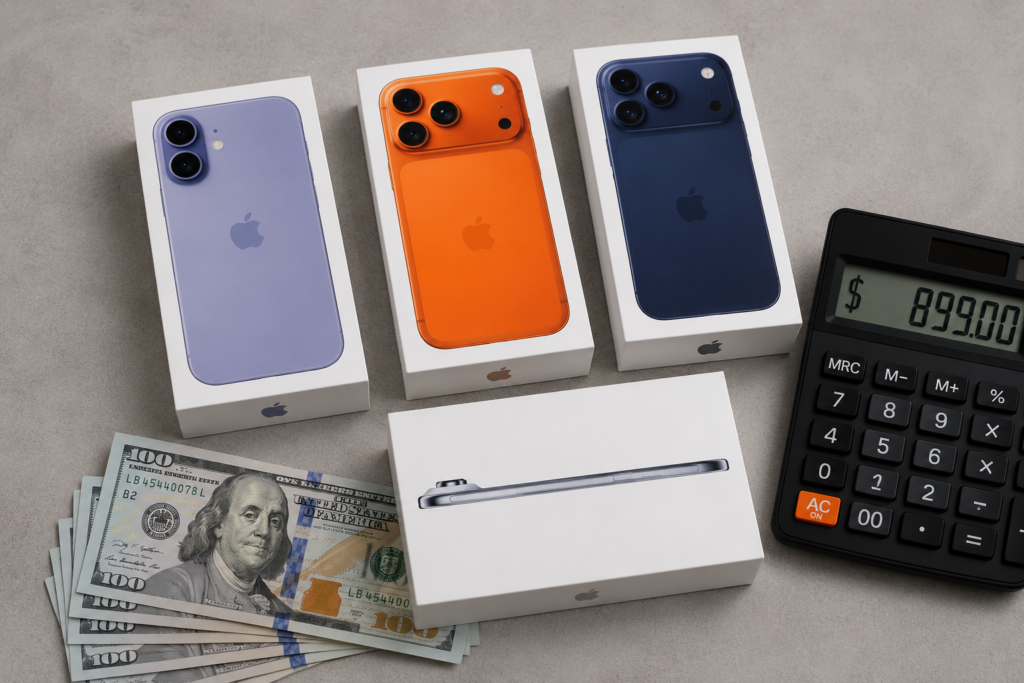
Buy the iPhone 17 Pro if you want the best all-around iPhone Apple sells right now — it has the triple camera, the fast USB-C port, and vapor-chamber cooling that actually holds up under load, for $300 less than the Pro Max. Buy the iPhone 17 Pro Max if you also want the longest battery life Apple has ever shipped and don’t mind the extra size and weight. Buy the plain iPhone 17 if you want 90% of the Pro experience — the same display, the same ProMotion, nearly the same chip — for $300 less and don’t need a telephoto lens. Skip the iPhone Air unless the thinness is the whole point for you: it’s the most compromised phone in the lineup on battery and camera, and even Apple’s retail partners have been discounting it hard, which tells you something about how it’s selling.
At a glance: how the four compare
| iPhone 17 | iPhone Air | iPhone 17 Pro | iPhone 17 Pro Max | |
|---|---|---|---|---|
| Price (Aug 2026, US) | $799 | $999 MSRP — street price has dropped to ~$849 at Best Buy and Amazon during 2026 sales | $1,099 | $1,199 |
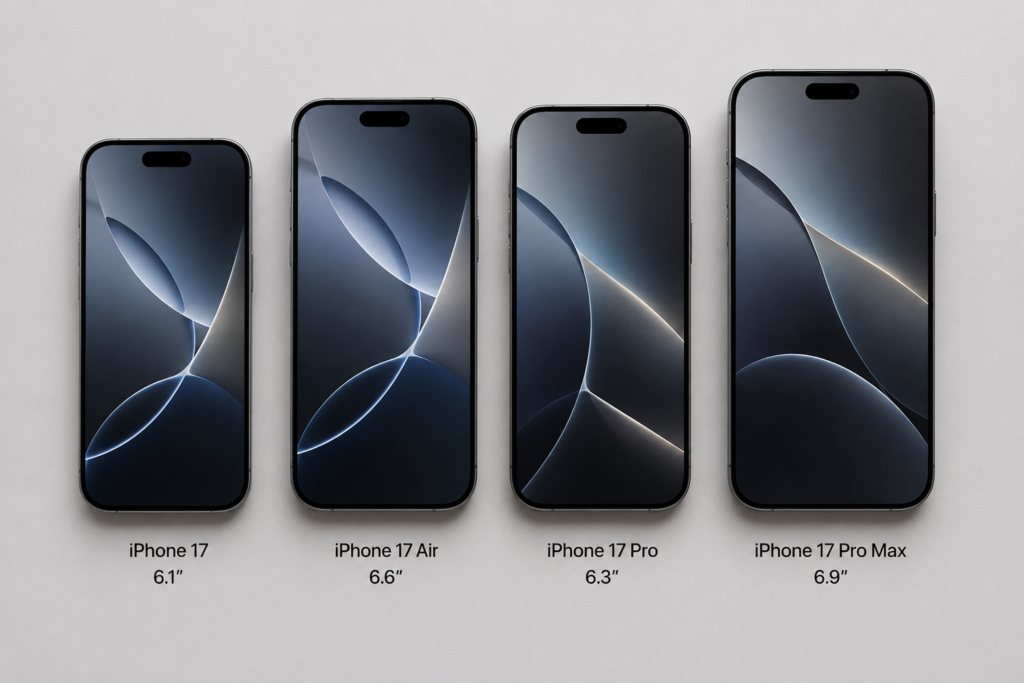
| Display | 6.3″, ProMotion 120Hz, 3,000-nit peak | 6.5″, ProMotion 120Hz, 3,000-nit peak — tie with all three others | 6.3″, ProMotion 120Hz, 3,000-nit peak | 6.9″, ProMotion 120Hz, 3,000-nit peak |
| Chip | A19 (5-core GPU) | A19 Pro (5-core GPU — GPU cut down to match base A19) | A19 Pro (6-core GPU, full) | A19 Pro (6-core GPU, full) |
| Cameras | Dual 48MP: Main + Ultra Wide | Single 48MP Main only — no ultra-wide, no telephoto | Triple 48MP: Main + Ultra Wide + 4x Telephoto | Triple 48MP: Main + Ultra Wide + 4x Telephoto |
| Apple-rated video playback | 30 hrs | 27 hrs — the shortest in the lineup | 33 hrs | 39 hrs — longest ever on an iPhone |
| Independent battery rundown¹ | 12:47 | 12:02 — shortest | 15:32 | 17:54 — longest |
| Build | Aluminum | Titanium, 5.6mm thick — thinnest iPhone ever | Aluminum unibody + vapor chamber cooling | Aluminum unibody + vapor chamber cooling |
| Weight | 177g | 165g — lightest | 206g | 233g |
| USB-C speed / wireless charging | USB 2 (480Mb/s), 25W MagSafe | USB 2 (480Mb/s), 20W MagSafe — slowest on both counts | USB 3 (10Gb/s), 25W MagSafe | USB 3 (10Gb/s), 25W MagSafe |
| Cellular | 5G sub-6 + mmWave | 5G sub-6 only, no mmWave (Apple C1X modem) | 5G sub-6 + mmWave | 5G sub-6 + mmWave |
| Storage tiers | 256GB / 512GB | 256GB / 512GB / 1TB | 256GB / 512GB / 1TB | 256GB / 512GB / 1TB / 2TB |
¹ Tom’s Guide and TechRadar’s standardized 5G web-browsing-at-150-nits rundown test, not Apple’s marketing figure.
Camera: the Pro models are the only ones with real flexibility
The iPhone 17 Pro and Pro Max share an identical camera system: a 48MP main, a 48MP ultra-wide, and a new 48MP telephoto with a tetraprism design giving 4x optical zoom (8x optical-quality with sensor crop). DxOMark’s testing puts the iPhone 17 Pro near the top of its camera rankings, with reviewers singling out video and zoom performance as best-in-class for the category, though it trails Huawei’s and Oppo’s latest flagships in DxOMark’s overall score by a handful of points. [UNVERIFIED: exact DxOMark overall score for iPhone 17 Pro — outlets summarizing the same test cite slightly different numbers; confirm on DxOMark’s live camera test page.]
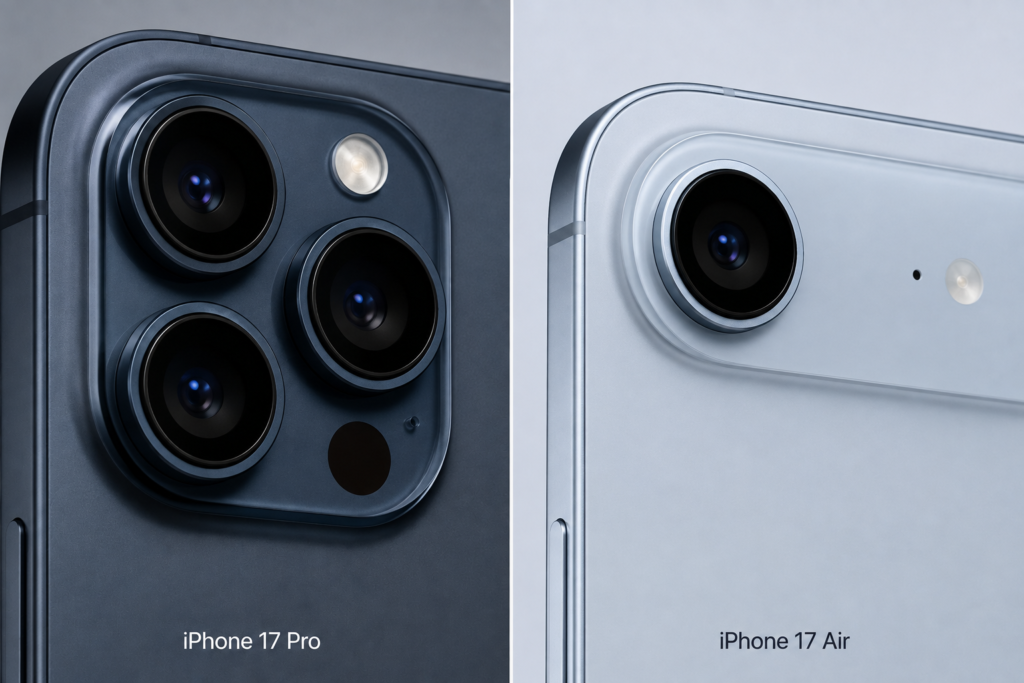
The base iPhone 17 drops the telephoto lens but keeps the ultra-wide, which is the more useful of the two for most people — group shots and landscapes come up more often than 4x zoom. The iPhone Air is the outlier: one camera, full stop. Apple gives it a 2x optical-quality crop mode, but there’s no ultra-wide for interiors or landscapes and no real telephoto for portraits at distance. Reviewers who tested it at launch called the single 48MP sensor sharp and capable in good and low light, but flagged the lack of a second lens as a real loss of flexibility, not just a spec-sheet gap.
Battery: this is where the Air actually loses, not just on paper
Apple’s own video-playback ratings and independent rundown tests agree on the order, even though the absolute numbers differ by methodology: Pro Max leads, Pro is a clear second, the base 17 is third, and the Air comes in last — behind even the cheaper standard model. That’s the direct cost of a 5.6mm body: there’s less physical room for a battery. Reviewers who lived with the Air for months describe it as “just okay” for a full day of typical use, better than early skeptics expected given the size, but not something you’d want on a long travel day without a case battery or an outlet.
The Pro Max’s 39-hour rated video playback and near-18-hour rundown score make it the best-battery iPhone Apple has ever built, helped by both its size and a vapor-chamber cooling system that keeps the chip from throttling and burning extra power under sustained load.
Performance and heat: the vapor chamber is a real upgrade, not marketing
The iPhone 17 Pro and Pro Max both switched from titanium back to an aluminum unibody this generation, specifically to pair with a laser-welded vapor chamber that moves heat off the A19 Pro chip faster. Independent stress testing found the Pro Max held roughly 81% of its peak performance after 20 minutes of sustained load, versus about 65% for the iPhone 16 Pro Max under the same test — a real, measurable gain, and reviewers have reported sustained 60fps gaming with no visible throttling in titles that made older Pro iPhones stutter.
The base iPhone 17 and iPhone Air don’t get the vapor chamber, and the Air’s GPU is cut down to 5 cores — identical to the plain A19 in the base model, even though it’s badged “A19 Pro.” Benchmark aggregators show roughly a 6% CPU and 15% GPU gap between the A19 and full A19 Pro. [UNVERIFIED: precise Geekbench/3DMark percentage gaps — figures vary slightly across benchmark aggregator sites; treat as directional, not exact.] In practice, that gap shows up in sustained gaming and video export, not in everyday scrolling and browsing, where all four phones feel equally fast.
Design and durability: thinness has a real cost here
The Air’s 5.6mm titanium body is the headline feature of this entire lineup, and it’s genuinely impressive to hold. But that thinness is also why it has the worst battery, the slowest charging (20W MagSafe versus 25W on every other model), no mmWave 5G, and only one camera — Apple used the internal volume for a bigger battery cell and a titanium frame instead of a second lens or a bigger charging coil. The Pro and Pro Max are the heaviest phones here (206g and 233g), but that weight buys the triple camera, faster USB-C, and the cooling system.
Where reviewers disagree
The iPhone Air is the most polarizing phone Apple released this generation, and reviewers have genuinely split on it rather than converging over time. Some outlets called it Apple’s most beautiful phone in years and praised the engineering required to fit a modern iPhone into 5.6mm. Others called it “Apple’s most beautiful flop,” pointing out that at $999 it sits just $100 below the triple-camera, better-battery iPhone 17 Pro and $150-plus above the base iPhone 17 — a pricing gap that’s hard to justify against what you give up. That disagreement isn’t just critic opinion: by mid-2026, reports pointed to weak Air sales pushing Apple to cut production and reportedly delay a second-generation model, and multiple retailers ran repeated discounts on it throughout the year rather than the usual slow post-launch price decay. When a phone’s own maker cuts its price and its production plan in the same year, that’s a stronger signal than any single review.
The other live debate is Pro versus Pro Max, and it’s less about which is “better” and more about tolerance for size. Every camera and performance spec is identical between them — the only real differences are screen size, weight, and battery. If you’ve never wanted a phone over 6.5 inches, the extra battery life on the Pro Max won’t change your mind; if all-day battery is your top priority, the size becomes worth it.
Who should buy which
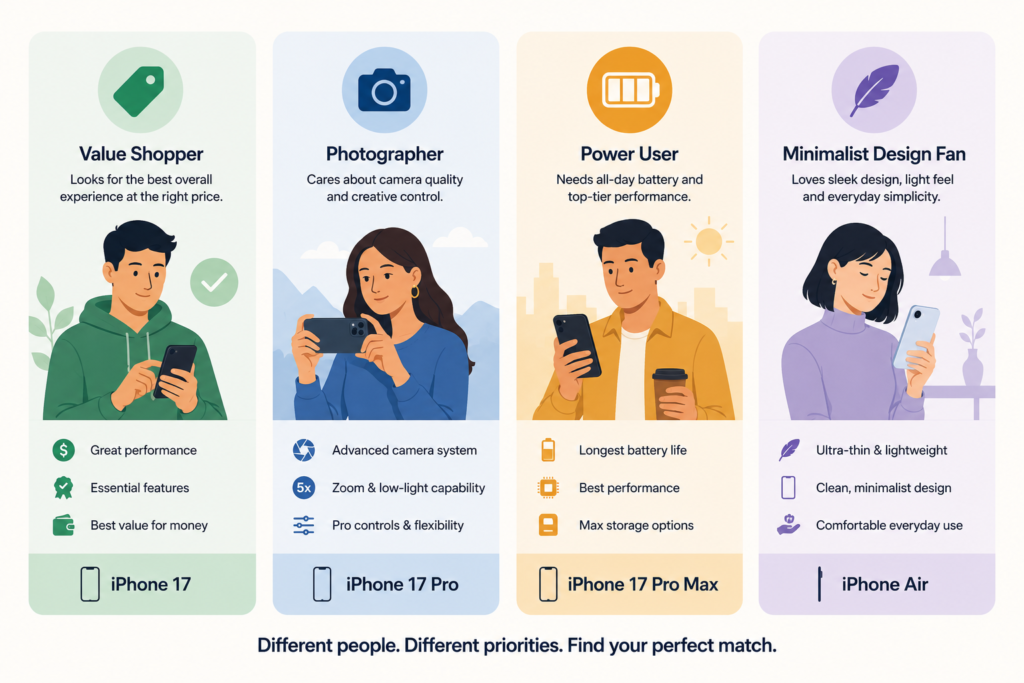
Upgrading from an iPhone 13 or older and want the best value: the base iPhone 17. You get the same display and ProMotion as the Pro, a chip that’s within single digits of the Pro’s in real-world use, and $300 back in your pocket.
Want the best camera and don’t want to compromise on battery: the iPhone 17 Pro. The triple camera and vapor-chamber cooling are the two upgrades that actually change daily use, and it’s $100 cheaper than the Air while doing more.
Heavy user who wants the longest battery life on any iPhone, ever: the iPhone 17 Pro Max. Accept the extra size and weight; there’s no other way to get 39 hours of rated video playback from Apple right now.
Specifically want the thinnest, lightest phone Apple makes and photography is a secondary concern: the iPhone Air — but go in knowing you’re trading battery life, a second camera, and mmWave 5G for it, and check current retail pricing first, since it’s been discounted well below MSRP for months.
Still on an iPhone 15 or newer: none of these four are a must-upgrade. Wait and see what iPhone 18 brings before spending money on incremental gains.
What would change this recommendation
Apple is expected to hold its next iPhone event in September 2026 — weeks from when this was written — but reporting from Bloomberg’s Mark Gurman and others suggests the fall event covers the iPhone 18 Pro, Pro Max, and a new foldable iPhone, while the standard iPhone 18 and a second-generation iPhone Air reportedly won’t arrive until spring 2027. [UNVERIFIED: exact September 2026 event date and any iPhone pricing increase — still rumor-stage as of early August 2026; confirm after Apple’s keynote.] That timing matters for this guide: if you’re eyeing a Pro-tier phone, a successor lands within weeks, so waiting has a real payoff. If you want the base iPhone 17 or the Air, you’re likely looking at the current models being the newest option in that tier until spring 2027 — so a further Air price cut is more probable than a replacement showing up soon.
FAQ
Does the iPhone Air have a SIM card slot?
No. The iPhone Air is eSIM-only worldwide, with no physical SIM tray at all — the first iPhone Apple has ever shipped this way globally. All four phones in this lineup are eSIM-only in the US, but the Air was the design that removed the tray entirely to make room for a bigger battery.
Which iPhone 17 model has the best camera?
The iPhone 17 Pro and Pro Max, tied — they share an identical triple-camera system with a 4x optical telephoto that neither the base iPhone 17 nor the iPhone Air gets. The base 17 keeps a useful ultra-wide but no telephoto; the Air has only a single camera.
Is the iPhone Air worth buying in 2026?
Only if the thinness and weight are the priority. It has the shortest battery life and weakest camera setup in the current lineup, and it costs more than the base iPhone 17 while offering less than the iPhone 17 Pro. Reviewers were split at launch, and by mid-2026 retailers were discounting it well below its $999 launch price — a sign demand hasn’t matched Apple’s expectations.
What’s actually different between the iPhone 17 Pro and Pro Max besides size?
Mainly battery life. The cameras, chip, and cooling system are identical. The Pro Max’s larger body allows a bigger battery, which is why it’s rated for 39 hours of video playback versus 33 hours on the Pro — otherwise you’re choosing based on how big a phone you want to carry.
Should I wait for the iPhone 18 instead of buying now?
If you want a Pro-tier phone, it’s worth waiting — Apple’s iPhone 18 Pro and Pro Max are rumored for September 2026, just weeks out. If you want the base iPhone 17 or iPhone Air tier, there’s no confirmed replacement until spring 2027 per current reporting, so buying now doesn’t cost you much runway.
Does the base iPhone 17 have the same 120Hz ProMotion display as the Pro models?
Yes. This is the first year ProMotion has come to the standard iPhone — the 17 and 17 Pro use the same 6.3-inch panel with the same brightness figures. Display quality is not a reason to pick the Pro over the base model.