
By the CompareBuyNow team | Updated August 2026 | Reading time: 11 minutes
Independent comparison. CompareBuyNow does not accept payment for placement or ranking.
You run a 12-person agency. Everyone on the team already has a free AI tab open, three people expensed a personal Pro subscription last quarter, and you are now being asked to pick one and pay for it properly. The problem is that every comparison article you find is written for either a solo freelancer or a 4,000-seat enterprise. Neither of those is you.
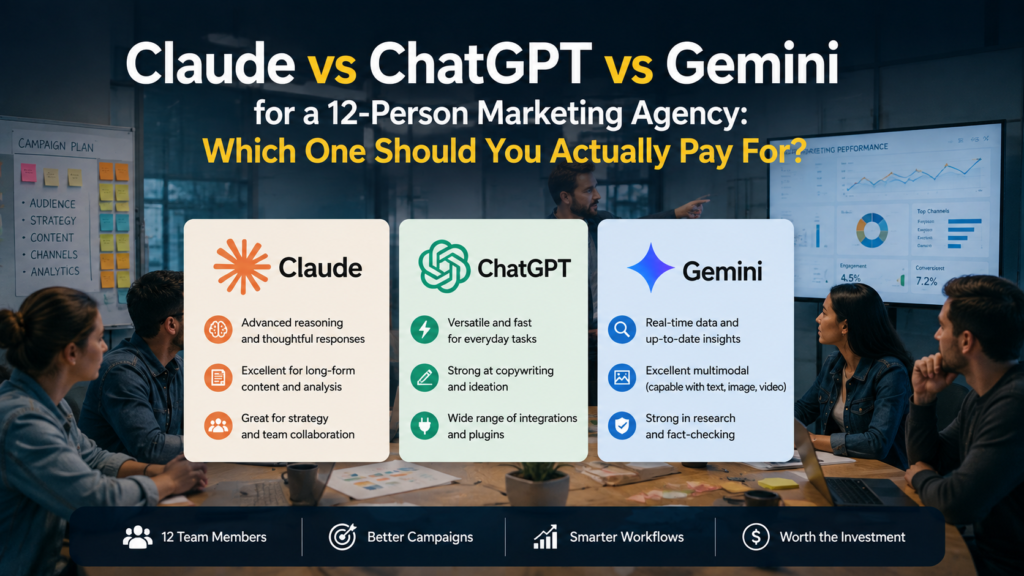
So we sized this specifically for a shop of twelve: roughly two or three account leads, four or five writers and strategists, a couple of designers, a paid-media person, and someone doing operations. Here is what each platform actually costs at that headcount, what it genuinely does better than the other two, and the one combination we would sign off on if it were our money.
| The short answer For most 12-person agencies, buy ChatGPT Business (~$2,880/year for 12 seats) as the house tool, and treat Gemini as something you are already paying for inside Google Workspace rather than a third bill. If your agency’s billable output is mostly writing and strategy rather than visual production, flip that: Claude Team is the better house tool, at the same price. Do not buy all three at full seat count. |
The 30-second version
| Claude (Team) | ChatGPT (Business) | Gemini (via Workspace) | |
| Best at | Long-form writing, brand voice, document analysis, strategy | Breadth: image generation, connectors, agents, everyday volume | Living inside Gmail, Docs, Sheets and Slides |
| Weakest at | No native photo-real image generation; smallest app ecosystem | Voice drifts toward generic without heavy prompting | Weakest as a standalone thinking partner |
| 12 seats / year | ~$2,880 (annual billing) | ~$2,880 (annual billing) | ~$2,000 for Workspace Business Standard, Gemini included |
| Buy it if | You sell words, positioning and thinking | You want one tool that covers 80% of everything | Your team already lives in Google Workspace |
What a 12-person agency actually needs (and what it doesn’t)
Before pricing, be honest about the workload. In our experience the AI work inside a small agency splits into six buckets, and they are not equally important:
- Client-facing copy — landing pages, email sequences, ad variants, social captions. This is where brand voice matters and where a bad output costs you a revision round.
- Research and synthesis — competitor teardowns, category research, reading a 60-page brand guideline before a pitch.
- Visual production — social creative, mood boards, concept visuals, quick mockups for a pitch deck.
- Decks and documents — pitch decks, monthly reports, scopes of work.
- Data work — pulling a campaign export into a sheet and getting an answer out of it.
- Internal admin — meeting notes, status emails, briefs, the endless recap.
What you almost certainly do not need is an enterprise AI platform. ChatGPT Enterprise is quote-only and reportedly carries a 150-seat minimum, which rules a 12-person shop out entirely. Gemini Enterprise, Google’s standalone agent platform, starts around $21 per seat but adds metered consumption charges on top — the sort of variable bill that is genuinely painful to forecast when your revenue is project-based. Both are the wrong shape for you. The self-serve business tiers are the right shape.
What it actually costs at 12 seats
All figures are per user, per month, on annual billing, as of August 2026. Monthly billing typically adds around $5 per seat across the board.
| Plan | Per seat / mo | 12 seats / mo | 12 seats / yr | Notes |
| Claude Team (Standard) | $20 | $240 | $2,880 | 2-seat minimum; Cowork and Slack connector included |
| Claude Team (Premium) | $100 | $1,200 | $14,400 | Adds Claude Code and much higher limits. Overkill for an agency |
| ChatGPT Business | $20 | $240 | $2,880 | 2-seat minimum; price cut by $5/seat in April 2026 |
| ChatGPT Enterprise | ~$45-$75 (quoted) | n/a | n/a | Reported 150-seat minimum. Not available to you |
| Workspace Business Standard | ~$14 | ~$168 | ~$2,016 | Includes email, Drive, Meet and full Gemini |
| Workspace Business Plus | ~$22-$28 | ~$264-$336 | ~$3,168-$4,032 | More storage and security, same core Gemini |
| Gemini AI Expanded Access | ~$20 (add-on) | ~$240 | ~$2,880 | Optional. Higher image/video limits and more automations |
The number that matters most: Claude Team and ChatGPT Business cost exactly the same at 12 seats. Price is not the tiebreaker between them. Capability is. Gemini looks cheapest only because its price is buried inside a Workspace bill you are probably already paying — the true incremental cost of Gemini for a Workspace Business Standard customer is zero.
| Watch the local-currency trap Workspace pricing shifts by region and Google adjusted list prices in 2026 when it folded Gemini into the base plans. Check your own admin console before budgeting — the number on the US marketing page may not be the number on your invoice. |
Claude: the one that writes like a person
Anthropic’s Claude is the strongest of the three at the single task agencies bill most for: writing that sounds like a specific brand rather than like an AI. It holds a tone instruction across a long document instead of drifting back to house style by paragraph four, and it is noticeably better at respecting negative constraints — “never use the word ‘elevate’, keep sentences under 18 words, no em dashes” — which is exactly the kind of note a client gives you.
For a 12-person agency the practical unlocks are Projects and Cowork. A Project is a persistent workspace with its own uploaded context, so you can create one per client, drop in the brand guidelines, tone-of-voice doc, past-approved copy and the current campaign brief, and have every writer on the team working from the same shared grounding rather than re-pasting the brief into a fresh chat each morning. Cowork, which is included on every Team seat and now runs on web and mobile as well as desktop, handles the multi-step chores: turn a folder of scattered call notes into a structured brief, build a spreadsheet from a screenshot, produce a first-pass report from raw exports.
Claude Design, launched in April 2026 and available to Team subscribers, partly closes the visual gap. It turns prompts, documents or brand assets into slides, one-pagers, mockups and landing pages while applying your own design system — genuinely useful for pitch decks and internal one-pagers. What it does not do is generate photo-realistic imagery. If your team needs a hero shot of a product on a marble countertop, Claude is not the tool.
Buy Claude Team if: your revenue comes from content marketing, B2B, PR, brand strategy or anything where the deliverable is a document. Skip it if your deliverable is mostly a JPEG.
ChatGPT: the one that covers the most ground
ChatGPT Business is the safest single purchase for a mixed agency, and the reason is breadth rather than any one standout skill. One $20 seat gets a writer, an image generator, a research agent, a data analyst and a connector layer into the tools you already run.
Image generation is the decisive factor for most agencies. GPT Image 2 is the current leader for photo-realism and — critically for marketing — for rendering dense text inside an image without mangling it. If your team produces social creative with copy baked into the frame, that capability alone justifies the seat, because the alternative is a separate design subscription.
Business seats also include 60-plus connectors, so ChatGPT can read from Google Drive, Slack, SharePoint and similar sources; ChatGPT Agent for multi-step tasks; Deep Research for the long competitor teardowns; and custom GPTs that you build once and share across the workspace. That last one is quietly the biggest small-agency lever: build a “Client X Copy Assistant” GPT loaded with the brand guidelines, and your junior writer gets the same starting point as your creative director.
The trade-off is voice. Left alone, ChatGPT’s default register is confident, tidy and faintly generic — the register clients have started to recognise. It will match a brand voice, but you have to do more work to get it there and more editing to keep it there.
Buy ChatGPT Business if: you want one bill and one tool that handles roughly 80% of everything, and your work mixes copy with visual output. This is the default recommendation for a reason.
Gemini: the one you’re probably already paying for
Gemini’s argument is not that it wins on capability. It is that it is already in the building. Since Google folded Gemini into Workspace in 2025, any agency on Business Standard or above already has full Gemini in Gmail, Docs, Sheets, Slides, Drive and Meet, plus expanded access to the standalone Gemini app, at no additional charge.
For a small agency that is a real advantage, because the adoption problem in a 12-person team is never the model — it is getting the two people who do not care about AI to open a new tab. Gemini removes the tab. Meeting notes are summarised where the meeting happened. The campaign export gets analysed inside the sheet it already lives in. Gems, Google’s custom-assistant feature, work like lightweight custom GPTs, and Gemini Notebook (the evolution of NotebookLM) is a strong research tool for pitch prep: load 20 sources, get a grounded synthesis with citations back to the source document.
On visuals, Nano Banana Pro is excellent at compositional control, brand consistency across many variants, and native 4K output — arguably better than GPT Image 2 when you need thirty on-brand variations of the same hero concept. Video generation via Veo is also bundled in, which neither competitor matches at this price.
Where Gemini falls down is as a standalone thinking partner. For a long strategic argument, a nuanced rewrite or a genuinely difficult analytical problem, it is the one of the three we reach for last. It is a superb assistant and a middling collaborator.
Buy Gemini if: you are already on Google Workspace — in which case you are not buying anything, you are switching it on. Upgrade from Starter to Business Standard if you are still on Starter, because Starter’s Gemini is deliberately limited and misses Docs, Sheets, Drive and Meet entirely.
Head to head, by the job you’re actually doing
| Agency task | Winner | Why |
| Long-form copy in a client’s voice | Claude | Holds tone and negative constraints across thousands of words |
| High-volume ad and social variants | ChatGPT | Fastest at volume; custom GPTs make output consistent across juniors |
| Social creative with text in the image | ChatGPT | GPT Image 2 leads on in-image text rendering |
| Hero visuals and brand-consistent variants | Gemini | Nano Banana Pro wins on compositional control and 4K output |
| Short-form video for social | Gemini | Veo is bundled into Workspace; the others charge or lack it |
| Competitor and category research | Tie: ChatGPT / Gemini | Deep Research vs Gemini Notebook; both cite well, different styles |
| Reading a 100-page brand guideline | Claude | Best long-document comprehension and least drift |
| Pitch decks and one-pagers | Claude (close) | Claude Design applies your design system; Gemini in Slides is faster but blunter |
| Campaign data in a spreadsheet | Gemini | It is already inside Sheets, which removes the export step |
| Meeting notes and internal admin | Gemini | Native in Meet and Gmail; zero behaviour change required |
| Client-confidential material | Tie: Claude / ChatGPT | Both business tiers exclude your data from model training by default |
The costs that don’t appear on the pricing page
- Seat waste. In a 12-person agency, three or four people will use AI daily and the rest will use it weekly at best. All three vendors bill per seat regardless. Start with the smaller number of seats and add rather than buying twelve on day one — both Claude Team and ChatGPT Business have a two-seat minimum, so you are free to start at six.
- Annual lock-in. The 20% saving on annual billing is real, but this market has repriced twice in eighteen months. OpenAI cut Business seats by $5 in April 2026. Paying monthly for the first quarter costs you about $180 across 12 seats and buys you the option to walk away.
- The admin tax. Someone has to own the workspace, build the shared Projects or GPTs, and keep the brand-voice documents current. Budget two hours a week for the first month. Skipping this is the single most common reason agency AI rollouts fail.
- Usage limits. All three throttle heavy users. Claude Team applies limits per member rather than pooling them, so one power user cannot starve the team — a genuine advantage if you have one person doing all the heavy lifting.
- Client contracts. Check your MSAs. A growing number of 2026 client agreements now require disclosure of AI use or restrict which vendors may process their material. Pick a tool your biggest client will accept before you pick the one your team prefers.
Our recommendation: three agencies, three answers
Agency A: content, B2B, PR — you sell words
Claude Team, 12 seats: ~$2,880/year. Add Workspace Business Standard if you are not already on it. Keep two ChatGPT Business seats (~$480/year) for the designer and the paid-media lead who need image generation. Total: roughly $3,360/year plus Workspace.
Agency B: full-service, social-heavy — you sell campaigns
ChatGPT Business, 12 seats: ~$2,880/year. This is the recommendation for the majority of 12-person agencies. Switch Gemini on inside the Workspace you already pay for and use it for Sheets, Meet and video. Give your two best writers a Claude Pro seat each (~$480/year) if copy quality is a recurring client complaint. Total: roughly $3,360/year plus Workspace.
Agency C: cost-sensitive, Google-native — you need this to just work
Google Workspace Business Standard alone: ~$2,016/year, Gemini included. Spend nothing else for one quarter. If your team hits real ceilings on writing quality, add six Claude Team seats. If they hit ceilings on image volume, add the AI Expanded Access add-on for the three people who need it. Total: $2,016/year, with a clear upgrade path.
| What we would not do Do not buy 12 seats of two different platforms. At $5,760/year that is a junior salary’s worth of budget spent on redundancy, and in every small agency we have looked at, the second tool ends up used by three people. Buy one platform broadly and the second one narrowly. |
The 30-day test to run before you commit
Pricing pages will not tell you which tool fits your team. This will. Take one real, recently completed client project — one you already have approved final deliverables for — and run it through all three on free or single-seat plans.
- Week 1: Give each tool the same brief and brand guidelines. Ask for the same 500-word landing page. Have the account lead who approved the original rank the three blind.
- Week 2: Same brief, three social creatives with headline text in the image. Rank blind again. This is where Claude will drop out and where the two Google-vs-OpenAI image engines separate.
- Week 3: Hand each one your messiest real input — a two-hour call transcript, a client’s chaotic feedback thread — and ask for a structured brief. This tests reasoning, not polish.
- Week 4: Count edit rounds. Not preference, not vibe. How many passes did each output need before it was client-ready? At agency rates, one saved revision round per week across twelve people pays for any of these subscriptions several times over.
Whichever tool won week 4 is the one to buy twelve seats of. Everything else in this article is a prior; that test is evidence.
Frequently asked questions
Is $20 a seat really the whole cost?
For Claude Team Standard and ChatGPT Business on annual billing, yes — both are flat per-seat with no usage metering. Monthly billing adds roughly $5 per seat. The tiers with variable costs are the enterprise platforms, which a 12-person agency should avoid.
Can we just use the free versions?
You can, and for a while it will feel fine. What you lose is the data-handling guarantee (paid business tiers exclude your content from model training by default), shared workspaces, admin controls, and higher limits. For client-confidential material, free tiers are a liability rather than a saving.
Which is best for SEO content at volume?
ChatGPT for throughput and structure, Claude for anything that needs to survive an editor. If you are producing content that has to rank and read well, the realistic answer is Claude for the draft and ChatGPT for the surrounding assets.
Does Claude generate images yet?
Not photo-realistic ones. Claude Design produces slides, mockups, one-pagers and layouts using your design system, which covers a lot of agency need — but for photography-style output you need ChatGPT or Gemini.
We’re a Microsoft shop, not Google. Does that change things?
It removes Gemini’s main advantage, since the free-because-bundled argument disappears. For a Microsoft-native agency the decision collapses to Claude versus ChatGPT on capability alone, and ChatGPT’s connector support for SharePoint gives it a small edge.
How long until this article is out of date?
Assume six months on features and twelve on pricing. Model rankings shifted three times in the last year and OpenAI cut Business pricing in April 2026. The strategic advice — one platform broadly, one narrowly, avoid enterprise tiers at this headcount — has been stable throughout.
The verdict
If you want a single sentence: buy ChatGPT Business for twelve, switch on the Gemini you already own inside Workspace, and give your two strongest writers Claude. That stack costs roughly $3,360 a year on top of Workspace, covers every one of the six agency workloads, and does not require anyone to change how they work.
If your agency’s product is thinking and writing rather than assets, invert it — Claude Team for twelve, ChatGPT for the two people making pictures. Same money, better fit.
What you should not do is spend three months debating it. The gap between the three platforms is smaller than the gap between an agency that has built shared, brand-loaded workspaces and one where twelve people paste the brief into a blank chat every morning. The tool matters less than the setup. Pick one this week, give someone ownership of it, and spend the saved deliberation on the rollout instead.
Sources and further reading
Pricing and feature details verified August 2026 against vendor documentation and current market reporting. Prices vary by region and billing term; confirm in your own admin console before committing.
- Google Workspace — official plan and pricing comparison: workspace.google.com/pricing
- OpenAI Help Center — What is ChatGPT Business: help.openai.com/en/articles/8792828
- OpenAI Help Center — Flexible pricing for Enterprise, Edu and Business plans: help.openai.com/en/articles/11487671
- Claude Help Center — What is the Team plan: support.claude.com/en/articles/9266767
- Anthropic — Introducing Claude Design by Anthropic Labs: anthropic.com/news/claude-design-anthropic-labs
- Anthropic — Claude Cowork product page: claude.com/product/cowork
- TechCrunch — Anthropic launches Claude Design (17 April 2026)
- eesel AI — ChatGPT for Work pricing: Business and Enterprise cost (2026)
- eesel AI — Gemini for Workspace pricing 2026
- Coworker AI — Gemini Enterprise Pricing 2026, Explained
- IntuitionLabs — Claude subscription plans and pricing 2026
ComparebuyNow is reader-supported and independently funded. We do not accept payment from vendors for inclusion, ranking or favourable coverage. Recommendations reflect our own testing and research.