The verdict up front
Pick Ahrefs if backlink analysis and link building are your main job — its index is larger, updates faster, and G2 reviewers rate its link-building tools well ahead of Semrush’s (9.2 vs. 8.2 out of 10). Pick Semrush if you need one subscription to cover SEO, PPC research, social media, and content in a single login, especially across a multinational client base — it’s rated stronger for keyword research breadth and it’s the only one of the two that also does paid-search intelligence and social media management. Neither is cheap, and “expensive” is the single most common complaint about both tools on G2, so budget for the add-ons before you commit to either.
At a glance: how they compare
| Semrush | Ahrefs | |
|---|---|---|
| Entry paid plan (Aug 2026) | $139.95/mo ($117.33/mo billed annually) — “SEO” plan | $129/mo ($108/mo billed annually) — “Lite” plan |
| Free option | Free plan: 1 project, 10 reports/day across all tools | Ahrefs Free: limited lifetime access to Site Explorer and Site Audit; no full free plan |
| Free trial | Yes — 7 days, cancel anytime | No — Ahrefs states plainly it doesn’t run trials or discounts |
| Cheapest way in | Free plan, $0 | Starter plan, $29/mo — limited to keyword/competitor lookups, not the full toolkit |
| Keywords tracked, entry tier | 500/day | 750 |
| Backlink index size (self-reported) | ~390M referring domains, ~43T links (third-party estimate — see note below) | 500.4M domains, 35T backlink records (Ahrefs’ own published stats, Aug 2026) |
| G2 rating | 4.4/5 (4,016 reviews) | 4.5/5 (708 reviews) |
| G2 — ease of use | 8.3/10 | 8.8/10 |
| G2 — link building | 8.2/10 | 9.2/10 |
| G2 — keyword research | 9.2/10 | 8.9/10 |
| Extra users | From $45/mo/user | $40–$100/mo/user depending on plan tier |
| Beyond SEO | Also does PPC intelligence, social media management, content creation, and AI-search-visibility tracking in the same login | SEO-focused only, plus an AI writing assistant add-on |
Backlink analysis and link building: Ahrefs’ home turf
Ahrefs was built as a backlink crawler first, and it shows. The company’s own published data (as of August 2026) puts its live backlink index at 35 trillion records across 493.9 billion pages and 500.4 million vetted domains, refreshed every 15 to 30 minutes. Semrush’s backlink numbers are usually cited around 390 million referring domains and roughly 43 trillion links in third-party comparisons, but Semrush doesn’t publish a directly comparable self-reported figure the way Ahrefs does, and refresh cadence is generally reported as slower — closer to every 2 to 4 weeks rather than near-real-time. [UNVERIFIED: Semrush’s exact self-reported backlink and keyword database totals — Semrush’s own stats page did not render usable figures during research; numbers cited here come from third-party aggregator comparisons and should be confirmed against Semrush’s live dashboard before publishing.]
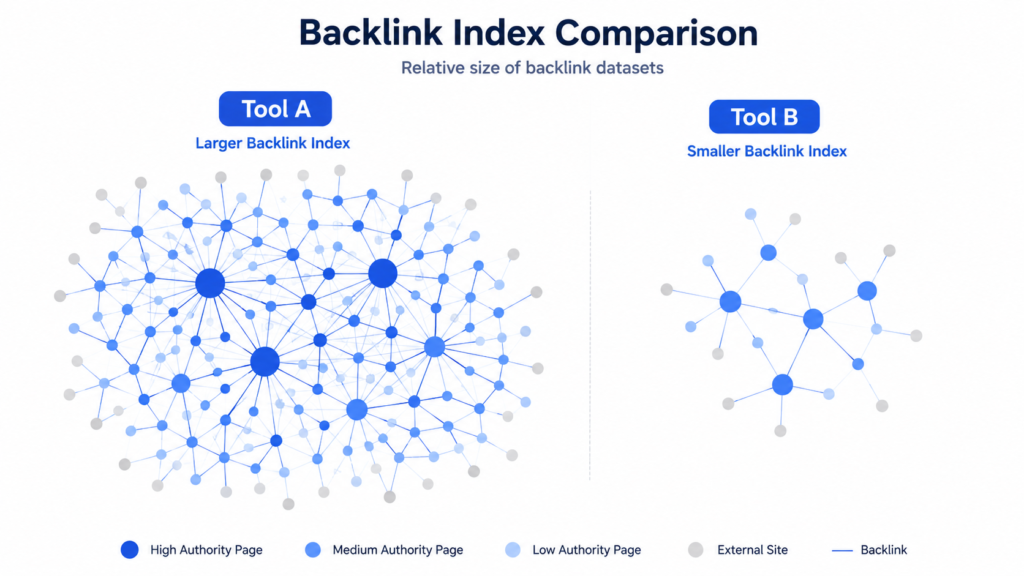
That data gap shows up in reviews: G2 users score Ahrefs’ link-building tools at 9.2 out of 10 versus Semrush’s 8.2, and “accurate keyword research” and backlink depth are the two most-cited reasons professional SEOs default to Ahrefs for competitive link audits, even when they keep a Semrush subscription for other work.
Keyword research and AI-search tracking: Semrush’s breadth shows
Semrush counters with keyword database breadth, particularly outside the US — third-party comparisons put its keyword coverage above 25 billion terms across 140-plus country databases, with especially strong non-English coverage that agencies with multinational clients rely on. Ahrefs’ own reported figure is 28.7 billion filtered keywords across 217 locations, so the two are closer than either marketing page suggests, and G2 reviewers actually rate Semrush’s keyword research feature slightly higher than Ahrefs’ (9.2 vs. 8.9).
Both companies have pivoted hard into AI-search visibility tracking as ChatGPT, Gemini, and Perplexity have started sending real traffic. Semrush now bundles AI-search-visibility tracking — prompt monitoring across Google Search, ChatGPT, Perplexity, and Gemini — into every paid tier starting at 50 tracked prompts/day on its entry plan. Ahrefs runs a similar feature called Brand Radar, tracking prompts across seven AI surfaces including AI Overviews, ChatGPT, Gemini, Copilot, and Grok, bundled starting at 5 prompts/day on its Lite plan and sold standalone from $199/mo for those who want AI tracking without the full SEO suite. Neither company had this as a bundled default two years ago — it’s the biggest structural change in either product’s plans this generation.
Pricing structure and total cost: the sticker price isn’t the real number
Comparing headline prices is misleading because both tools charge extra once you add people or exceed limits, and that’s where most of the “expensive” complaints on G2 come from — it’s the single most common con cited for both tools (507 reviews for Semrush, 44 for Ahrefs, proportionally similar given each tool’s review volume).
Ahrefs is transparent about the ceiling: its pricing page publishes exact export-row limits (500,000/month on Lite, up to 4 million on Advanced) and crawl-credit caps, and additional seats cost $40 to $100 per month depending on tier. Semrush’s add-on model is more piecemeal — extra users start at $45/mo, and features like white-labeled reports ($20/mo) or a “verified agency” lead-gen badge ($90/mo) are separate purchases rather than tier upgrades. If you’re pricing this out for a team of five, get the actual per-seat total from each vendor’s calculator before comparing sticker prices — neither company’s $129 or $139 headline figure is what a real team ends up paying.
One clear, verifiable difference: Semrush offers a genuine 7-day free trial on its paid plans. Ahrefs’ own FAQ states outright that it “never runs discounts” and has no full free trial — your only no-cost options are the permanently limited Ahrefs Free tier or the $29/mo Starter plan, which only covers keyword and competitor lookups, not the full toolkit.
Breadth: all-in-one marketing platform vs. SEO specialist
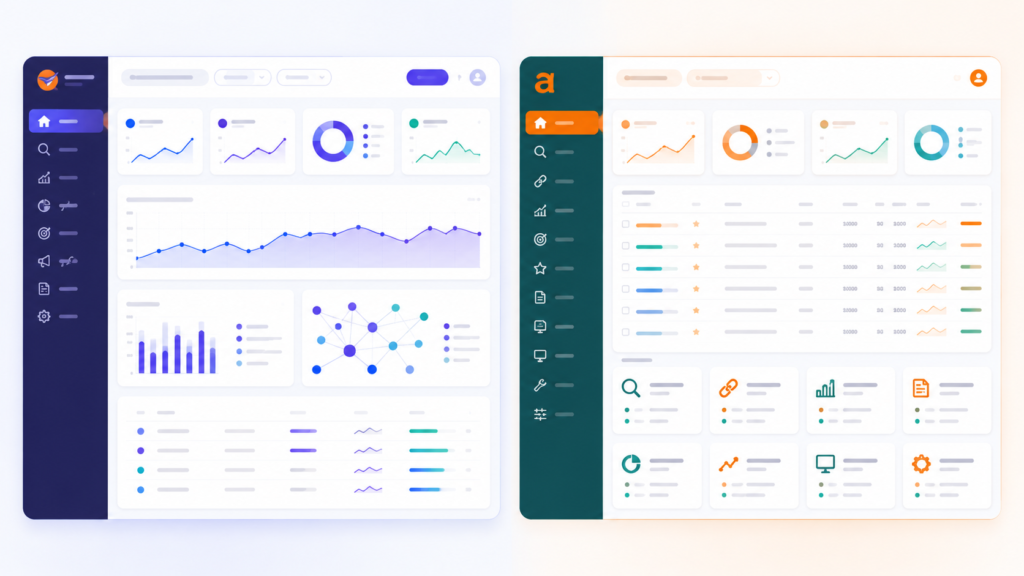
This is the least ambiguous difference between the two. On G2’s category comparison, Semrush competes in 12 software categories that Ahrefs doesn’t touch at all — social media management, paid search intelligence, market intelligence, content creation, marketing analytics, and answer-engine-optimization tools among them. Ahrefs, by contrast, has essentially one category advantage of its own (AI writing assistant tools) and otherwise stays inside SEO: backlinks, keywords, rank tracking, site audits, and content discovery. If your job is specifically SEO, that focus is arguably a feature, not a gap. If you’re the only marketing hire at a small company and need PPC research, social scheduling, and SEO under one login to justify a single tool budget, Semrush’s breadth is the more defensible purchase even if any one feature inside it is less deep than a dedicated tool.
Where reviewers disagree
The split isn’t really about which tool is “better” — it’s about which job you’re hiring it to do. Professional SEOs on Reddit and in agency blog posts consistently describe using Ahrefs for backlink research, content exploration, and competitor link audits, while keeping Semrush around for site audits, PPC research, local SEO, and client-facing reporting — using both rather than picking one. That’s a meaningfully different conclusion than either vendor’s own marketing implies, and it’s worth taking seriously if your budget can stretch to it.
The other disagreement is about ease of use versus depth. G2 reviewers rate Ahrefs higher on ease of setup (9.0 vs. 8.6) and ease of use (8.8 vs. 8.3), consistent with its reputation as the more focused, less cluttered interface. Semrush users don’t dispute this so much as argue it’s the tradeoff for getting everything — PPC, social, content, and AI-visibility reporting — without leaving the platform. Neither side is wrong; they’re optimizing for different things.
Who should buy which
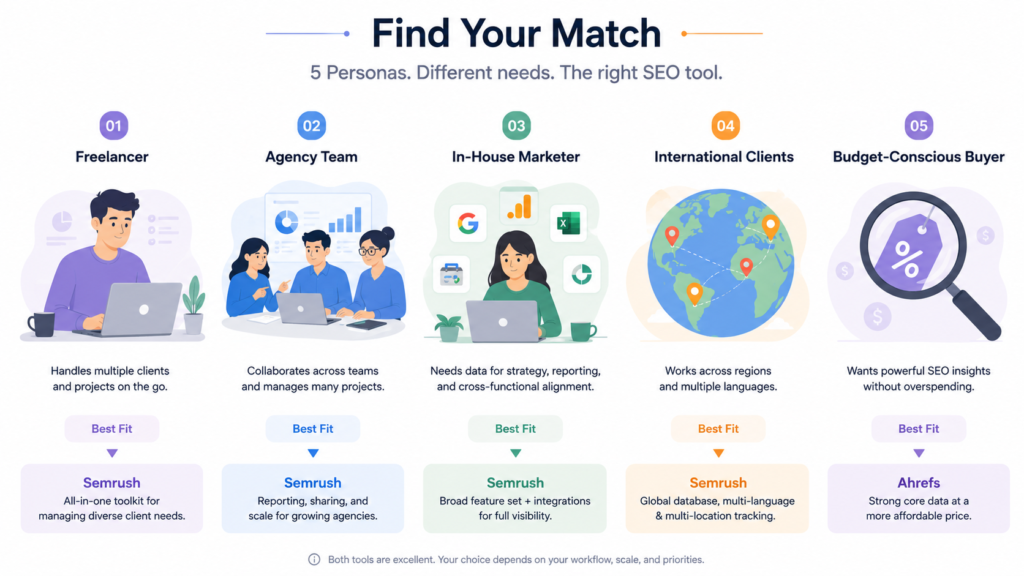
Link builders and agencies doing competitive backlink audits: Ahrefs. The larger, faster-refreshing backlink index and the 9.2/10 G2 score for link building are hard to argue with if this is your core deliverable.
Solo consultants and freelancers on a tight budget who mostly need keyword and competitor research: Ahrefs’ Lite plan at $129/mo edges out Semrush’s $139.95/mo entry tier on both price and keyword-tracking volume (750 vs. 500 keywords/day), and its interface has a shorter learning curve.
In-house marketers who need SEO, PPC, and social reporting in one tool: Semrush. It’s the only one of the two that also covers paid search intelligence and social media management, so you’re not paying for a second platform to fill those gaps.
Agencies serving multinational or non-English-speaking clients: Semrush, for its broader country-level keyword coverage and localization score edge (8.2 vs. 7.8 on G2).
Anyone who wants to try before they buy: Semrush — it’s the one with an actual 7-day free trial. Ahrefs makes you commit to a paid plan or settle for its permanently limited free tier.
What would change this recommendation
Both companies are actively rebuilding their pricing and product lineups around AI-search visibility, and that’s moving fast enough that plan names and limits from even six months ago are already out of date — Semrush’s current entry-level plan is called “SEO,” not the “Pro” name still used on most third-party comparison sites and even on some review aggregators. [UNVERIFIED: Confirm Semrush’s live plan names and pricing directly on semrush.com/pricing before publishing — naming has changed at least once in 2026 and third-party sites are inconsistent.] If either company restructures pricing again or if AI-search prompt tracking becomes the primary battleground rather than an add-on, the calculus here could shift within a quarter, not a year.
FAQ
Is Ahrefs or Semrush better for backlink analysis?
Ahrefs. Its self-reported backlink index (35 trillion records, 500.4 million domains as of August 2026) is larger than the figures typically cited for Semrush, it refreshes closer to real time, and G2 reviewers score its link-building tools at 9.2/10 versus Semrush’s 8.2/10.
Does Ahrefs have a free trial?
No. Ahrefs explicitly states it doesn’t offer discounts or a full free trial — your no-cost options are the permanently limited Ahrefs Free tier (basic Site Explorer and Site Audit access) or the low-cost $29/mo Starter plan, which doesn’t include the full toolkit.
Which tool is cheaper for a five-person agency?
It depends on usage, not just the sticker price. Ahrefs charges $40–$100 per additional user depending on tier; Semrush charges from $45/mo per additional user plus separate add-ons for things like white-labeled reports. Get an actual quote for your team size from both before deciding — headline prices don’t include this.
Can I use Semrush and Ahrefs together?
Many agencies do exactly that — using Ahrefs for backlink audits and content discovery while keeping Semrush for site audits, PPC research, and client reporting. It’s a common workaround if your budget allows a second subscription rather than a compromise on one.
Which has the bigger keyword database?
They’re close enough that the marketing claims from each company overstate the gap. Ahrefs’ own reported figure is 28.7 billion filtered keywords across 217 locations; Semrush is typically cited above 25 billion across 140-plus countries in third-party comparisons. In practice, G2 reviewers rate Semrush’s keyword research feature slightly higher (9.2 vs. 8.9).
Does either tool track AI search visibility like ChatGPT mentions?
Yes, both added this in the past year. Semrush bundles AI-search-visibility tracking (Google Search, ChatGPT, Perplexity, Gemini) starting at 50 tracked prompts/day on its entry plan. Ahrefs’ equivalent, Brand Radar, tracks seven AI surfaces starting at 5 prompts/day on its Lite plan, or as a standalone product from $199/mo.