The short version
POLED and AMOLED aren’t two competing display technologies — POLED is a substrate variant that exists inside the broader AMOLED category, and most phones marketed as “AMOLED” today are built the same way as the ones marketed as “POLED.” Android Authority put it plainly after comparing them directly: for most buyers, the choice between POLED and AMOLED “will be of little consequence.” If a phone’s spec sheet lists one or the other, don’t let that single word decide anything — check the actual measured brightness, color accuracy, and refresh rate instead, because those numbers tell you far more than the display’s marketing label does.
POLED vs AMOLED at a glance
| What it actually describes | AMOLED | POLED | Does it matter? |
|---|---|---|---|
| What the term technically refers to | Active-matrix driving method (a TFT array controlling each pixel) | Plastic substrate material | Different axis entirely — not a real “vs” |
| Is one a type of the other? | The umbrella term; nearly all modern phone OLEDs are active-matrix | A substrate variant that is itself built as an active-matrix (AMOLED) panel | POLED panels are AMOLED panels |
| Who uses the branding | Samsung (“Super AMOLED,” “Dynamic AMOLED 2X”) | LG Display (“P-OLED”), historically on Google Pixel and LG’s own phones | Branding choice, not a technical split |
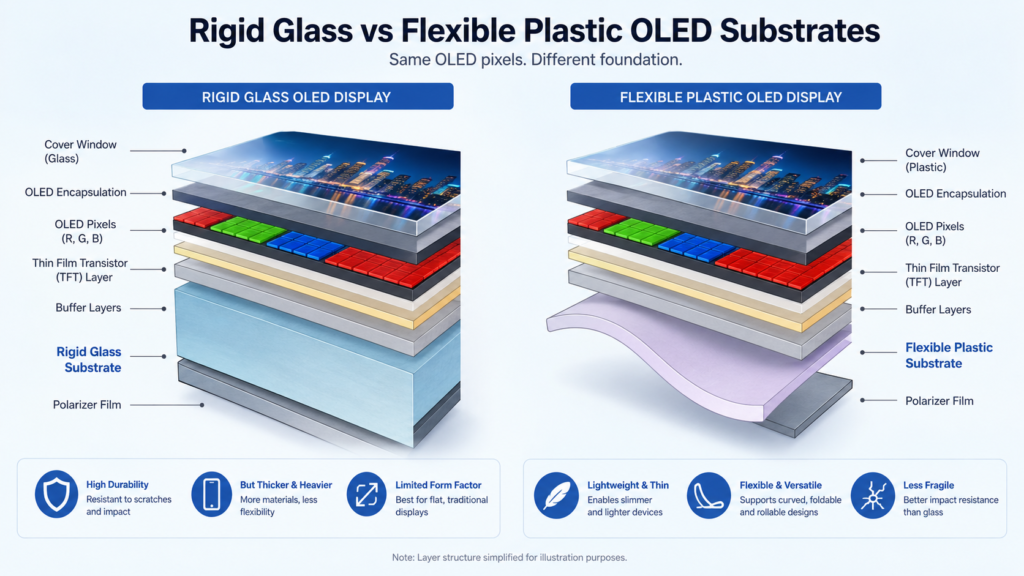
| Substrate in practice | Can be glass (rigid) or plastic (flexible) — Samsung uses both depending on the phone | Always plastic, by definition | The real variable is glass vs. plastic, which both brands mix |
| Example: same brand, two substrates | Galaxy S24 FE used rigid glass; Galaxy S25 FE moved to flexible plastic — both called “AMOLED” | — | Confirms “AMOLED” alone doesn’t tell you the substrate |
| Flexibility / foldability | Only the plastic-substrate versions bend; rigid-glass AMOLED phones don’t fold | Plastic substrate enables bending by design | POLED (by definition, though flexible AMOLED matches it) |
| Peak brightness & color gamut | Historically slightly ahead in Samsung’s flagship panels | Historically “fell slightly short,” per Android Authority’s testing summary | Gap has narrowed to the point of being negligible on current phones |
| Durability / shock resistance | Comparable on flexible variants | Comparable on flexible variants; plastic is inherently more shock-resistant than glass | Tie between flexible AMOLED and POLED; both beat rigid glass here |
| Burn-in history | No unusual pattern reported industry-wide | An early LG POLED panel drew burn-in-style complaints on the 2017 Google Pixel 2 XL, though later reporting suggested much of it was temporary image retention rather than permanent damage | Old, panel-specific incident — not a current-generation concern |
| Price impact | Samsung’s flexible AMOLED panels carry a premium reserved for flagship tiers | LG’s POLED panels have historically been positioned as the more cost-competitive option for mid-range phones | Budget signal, but an indirect one |
| Should it change your purchase decision | — | — | No — check brightness, color, and refresh rate specs instead |
What’s actually happening — the terms describe different things
The confusion starts with what each acronym is actually naming. AMOLED stands for Active-Matrix OLED, and it describes how a panel drives its pixels — a thin-film transistor array controls each pixel’s charge individually, which is what let OLED screens scale up to smartphone resolutions without the lag and lifespan problems of older passive-matrix OLED. POLED stands for Plastic OLED, and it describes what the panel is built on — a flexible plastic substrate instead of rigid glass.
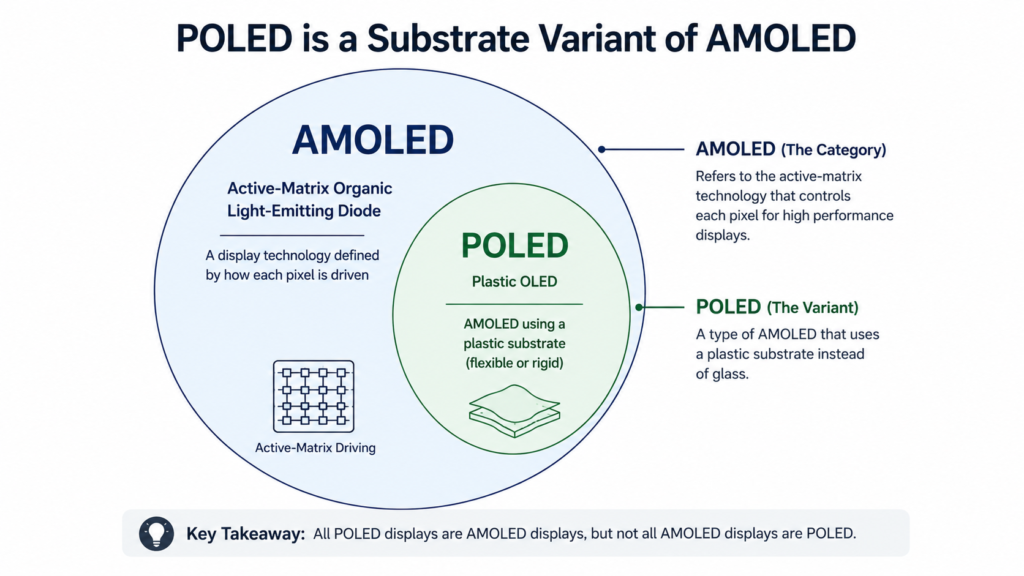
Those are two different axes, not two ends of the same spectrum. A panel can be active-matrix and built on plastic at the same time, and in fact that’s exactly what most current flagship phones do. As Android Police put it in their explainer, “many AMOLED displays use plastic substrates, benefiting from POLED screens’ advantages” — meaning a huge share of the phones marketed simply as “AMOLED” are, structurally, POLED panels too. The “vs” in “POLED vs AMOLED” is a framing borrowed from marketing rivalry between Samsung and LG Display, not a genuine technical fork.
Why now — foldables are reviving the plastic-vs-glass question
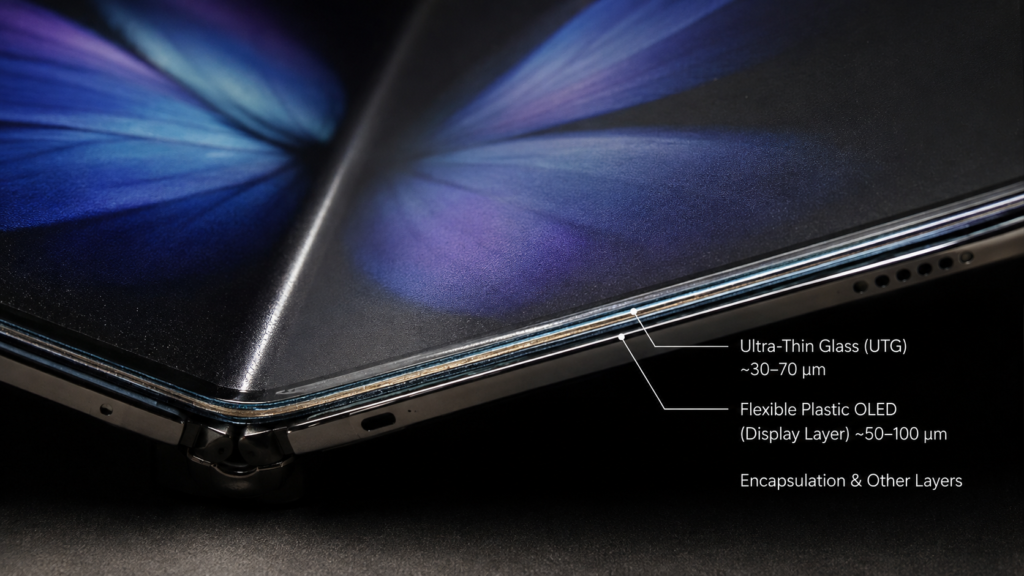
The substrate question is getting more attention in 2026 because foldable phones depend on it directly, and the industry is actively rethinking the tradeoff. Samsung is reportedly bringing an upgraded ultra-thin glass (UTG) layer to the Galaxy Z Fold 8, expected in the second half of 2026, cutting visible crease depth by roughly 20% compared to the Z Fold 7 by combining thinner glass with a laser-drilled backplate that spreads out mechanical stress [UNVERIFIED: sourced from a pre-launch supply-chain report (TrendForce), not a Samsung announcement or independent teardown — specs could change before launch]. Samsung Display is also expected to supply panels — built differently for each customer — for Apple’s rumored first foldable iPhone [UNVERIFIED: Apple has not confirmed a foldable iPhone or its display construction; this is a secondhand supply-chain report].
That matters here because it shows the industry moving toward hybrid constructions that layer thin glass with flexible material, rather than a clean plastic-versus-glass choice. The practical result is that “is this panel plastic or glass” is becoming a harder question to answer from a spec sheet with each new foldable generation, which makes the old “POLED vs AMOLED” framing even less useful as a shorthand than it already was.
What it means for someone buying a phone today
If you’re comparing two non-folding phones and one lists “AMOLED” while the other lists “POLED,” that single word shouldn’t move your decision. Compare the numbers that actually vary: peak brightness in nits, color gamut coverage, refresh rate, and — if you can find it — an independent outlet’s measured results rather than the manufacturer’s claimed spec. Android Authority’s own conclusion after directly testing panels from both camps was that the practical gap has closed enough that it “will be of little consequence” for a typical buyer choosing between current phones.
If you’re specifically shopping for a foldable, the substrate question becomes more directly relevant, because it’s foldables — not flat phones — where plastic-vs-glass construction shows up as a visible, felt difference: crease depth, screen protector compatibility, and long-term scratch resistance all trace back to what’s under the display. That’s the one case where asking “is this glass, plastic, or a hybrid” is worth doing before you buy, rather than trusting the AMOLED or POLED label alone.
Who benefits, who doesn’t
Foldable phone shoppers benefit most from understanding this distinction, since substrate construction directly affects crease visibility and long-term durability in a way flat-phone buyers never encounter. Budget and mid-range phone shoppers benefit from knowing that “POLED” on a spec sheet isn’t a red flag — LG Display’s panels have historically been positioned as the more cost-competitive option, and the brightness and color gap that used to separate them from Samsung’s panels has narrowed. Flagship flat-phone shoppers get essentially nothing actionable from this distinction either way; the panels in that tier are close enough that other specs should drive the decision. Reviewers and spec-sheet readers who assume “AMOLED” automatically means “premium, non-bending glass” are the ones most likely to be misled, since Samsung’s own lineup — the Galaxy S24 FE on rigid glass, the Galaxy S25 FE moving to flexible plastic — shows that a single brand markets both substrate types under the identical “AMOLED” name.
Where sources actually disagree
Most technical explainers agree on the structural facts above; where framing differs is in how seriously to take the historical brightness and color gap. Android Authority’s direct comparison found LG’s older POLED panels fell measurably short of Samsung’s AMOLED panels in peak brightness and color gamut coverage, and treats that as a real, if shrinking, difference worth knowing about. Other explainers, including Android Police’s, lean harder into “the differences aren’t noticeable enough to stress over” without quantifying a gap at all. The honest read is that the gap was real in earlier LG POLED generations, has narrowed significantly, and matters more if you’re comparing a budget POLED phone against a flagship AMOLED one than if you’re comparing two phones in the same price tier — at that point you’re likely comparing panel quality within a tier, not the substrate branding itself.
Who should care about this label — and who should ignore it
A foldable phone shopper comparing crease depth and long-term hinge durability across models should care about the actual substrate and glass-hybrid construction, not just whichever marketing term appears on the box. A flat-phone shopper picking between two similarly priced flagships should ignore the POLED/AMOLED label entirely and compare measured brightness, color accuracy, and refresh rate instead. A budget-conscious buyer seeing “POLED” on a mid-range phone shouldn’t read that as a downgrade — it signals a specific supplier and cost position, not an inferior display category. Anyone who’s read that POLED panels are more prone to burn-in should know that the one widely cited case, the 2017 Google Pixel 2 XL, is nearly a decade old and doesn’t reflect current-generation panels from either supplier.
What to watch next
Ultra-thin glass adoption in foldables is the trend most likely to make this whole comparison feel dated within a couple of years. If Samsung’s UTG approach on the Z Fold 8 and Apple’s rumored foldable iPhone both lean toward glass-plastic hybrids rather than pure plastic substrates, “POLED” as a distinct, plastic-only category may matter even less by the time the next generation of foldables ships. Worth a second look once the Z Fold 8 and any Apple foldable are independently tested and their actual substrate construction is confirmed rather than reported secondhand.
FAQ
Is POLED the same as AMOLED?
Not exactly, but they’re not opposites either. AMOLED describes how a panel drives its pixels (active-matrix); POLED describes what it’s built on (plastic instead of glass). A POLED panel is technically still an AMOLED panel — it just uses a plastic substrate. Most current flagship phones use flexible, plastic-substrate AMOLED panels, meaning they’re structurally similar to what “POLED” describes.
Which is better, POLED or AMOLED, for a new phone in 2026?
Neither is inherently better — the substrate label alone doesn’t determine quality. Compare the phone’s actual measured brightness, color gamut, and refresh rate instead. Android Authority’s direct testing found the historical brightness and color gap between LG’s POLED panels and Samsung’s AMOLED panels has narrowed enough to be “of little consequence” for most buyers.
Does POLED burn in more easily than AMOLED?
There’s no strong evidence of a systemic difference between current-generation panels. The most cited example — the 2017 Google Pixel 2 XL — involved an early LG POLED panel generation, and later reporting suggested much of what was flagged as burn-in was actually temporary image retention rather than permanent damage. It’s not a meaningful concern for phones sold today.
Why does Samsung call its phones “AMOLED” if some use plastic and some use glass?
Because “AMOLED” describes the pixel-driving technology, not the substrate — so it’s technically accurate for both. Samsung markets rigid-glass panels (like the Galaxy S24 FE’s) and flexible plastic panels (like the Galaxy S25 FE’s and its main flagship line) under the same “AMOLED” family name, which is exactly why the label alone can’t tell you which construction a given phone uses.
Do foldable phones use POLED or AMOLED?
Foldables require a flexible substrate to bend, so they use plastic-substrate panels by necessity — which fits the technical definition of POLED even when a manufacturer brands them “AMOLED.” Samsung’s foldables are increasingly adding ultra-thin glass layers on top of or alongside that plastic substrate, creating hybrid constructions that don’t cleanly fit either label.